A Sedative Side Effect: Two Weeks of Sleep Data
A data-driven look at how sleep duration, schedule, and composition shifted before and after taking a medicine that happened to have sedative effects.

I got a medicine from someone. It was not for sleep. I googled the name and it is not classified as a sleep aid. But it has sedative effects listed in the side effects. And my sleep data showed a clear before and after. This is what I saw.
The Setup
I have been tracking my sleep with a Huawei Fit 3 smartwatch. But I do not wear it every night. The "before" data is just random nights from March and April where I happened to sleep with the smartwatch. Not every night, not consistent. The "after" data is about two weeks in July after I started the medicine.
The data includes:
- Sleep duration (hours and minutes)
- Bed time and wake time
- Sleep stages (deep, light, REM)
- A sleep quality score (0-100)
I plotted everything side by side to see if the effect was real.
Sleep Duration Went Up
Before the medicine, my average sleep duration was about 7.3 hours. Some nights I got as little as 5.8 hours. After, it jumped to about 9.3 hours. That is a 2-hour increase.
Keep in mind the before data is messy. I did not track every night. But the pattern is still visible.
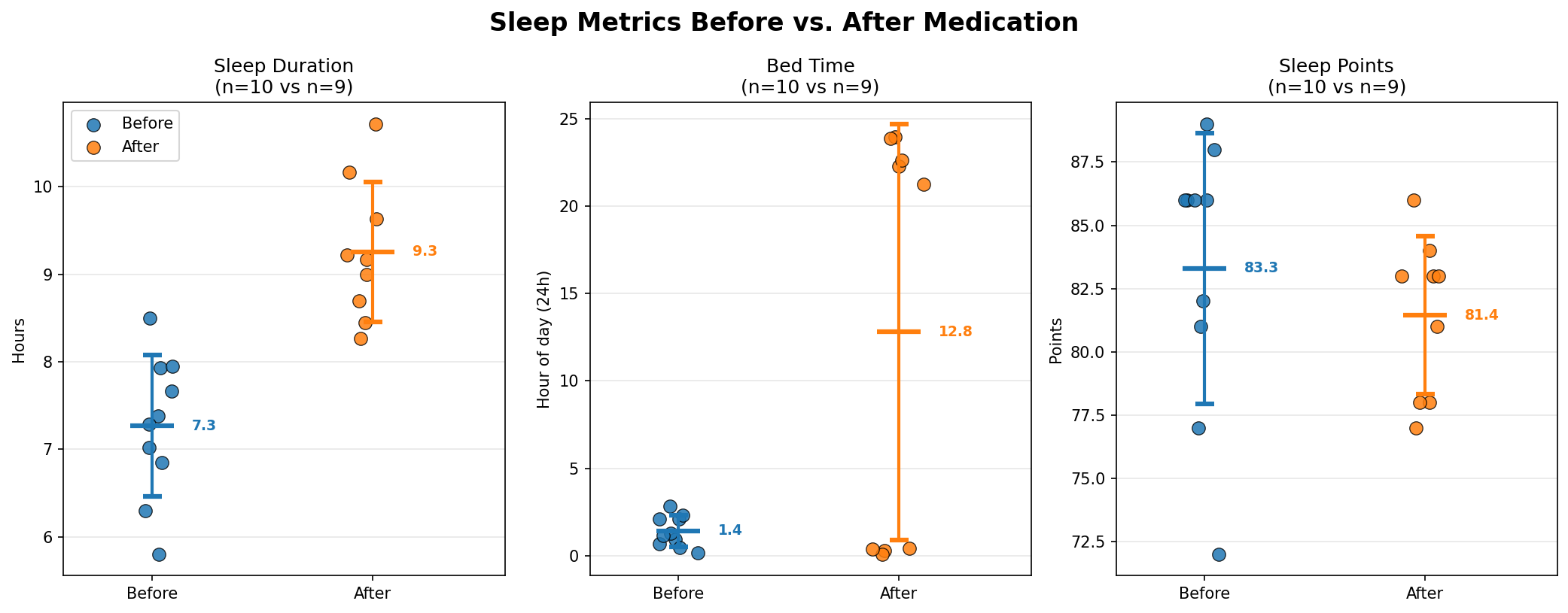
The individual data points show the difference clearly. Before, the points cluster around 6-8 hours. After, they sit around 9-10 hours. No overlap.
But here is the thing. The medicine did not make me fall asleep instantly. Before, it took me 30 to 90 minutes. After, it takes me 15 to 60 minutes. So the improvement is real, but it is not magic. I still need some time to wind down.
Bed Time Shifted Three Hours Earlier
This was the most obvious change. Before the medicine, I went to bed between 00:11 and 02:51. After, I went to bed between 21:16 and 00:25.
My average bed time moved from around 01:30 AM to around 10:30 PM. That is a three-hour shift earlier.
The reason is simple. Before the medicine, it took me 30 to 90 minutes to fall asleep. I knew this. So I delayed going to bed. Why lie in bed awake for an hour if I could just stay up and do something else?
The medicine changed that. I felt confident I could fall asleep quickly. So I went to bed earlier without dreading the wait.
My wake time stayed roughly the same (around 08:40-08:55 AM) because I have to be at work at 9:30. So I was not going to bed earlier and waking up earlier. I was going to bed earlier and sleeping longer.
Sleep Scores Did Not Improve
Here is the strange part. My sleep quality score did not get better. It actually went down slightly.
Before the medicine, my average score was around 83. After, it was around 81. This is not a big drop, but it is not the improvement I expected.
The score comes from Huawei TruSleep. It tracks heart rate, movement, and breathing to detect sleep stages [1]. Huawei says a normal person usually experiences 4 to 6 sleep cycles per night, with each cycle lasting 90 to 100 minutes [2]. That works out to 6 to 10 hours of sleep. So the algorithm considers this the healthy range.
Some of my nights after the medicine went over 10 hours (10h 43min, 10h 17min, 10h 10min). That is outside the healthy range according to Huawei. So the algorithm might be lowering the score because of that, not because the sleep quality is actually worse.
It makes sense if you think about it. The score is built around a 6-10 hour window. If you sleep beyond that, the algorithm does not know how to score it positively. It treats it as outside the norm.
I do not think my sleep got worse. I think the scoring system was not designed for someone sleeping 10+ hours.
Sleep Stage Composition Changed
I looked at deep, light, and REM sleep to see if the mix shifted.
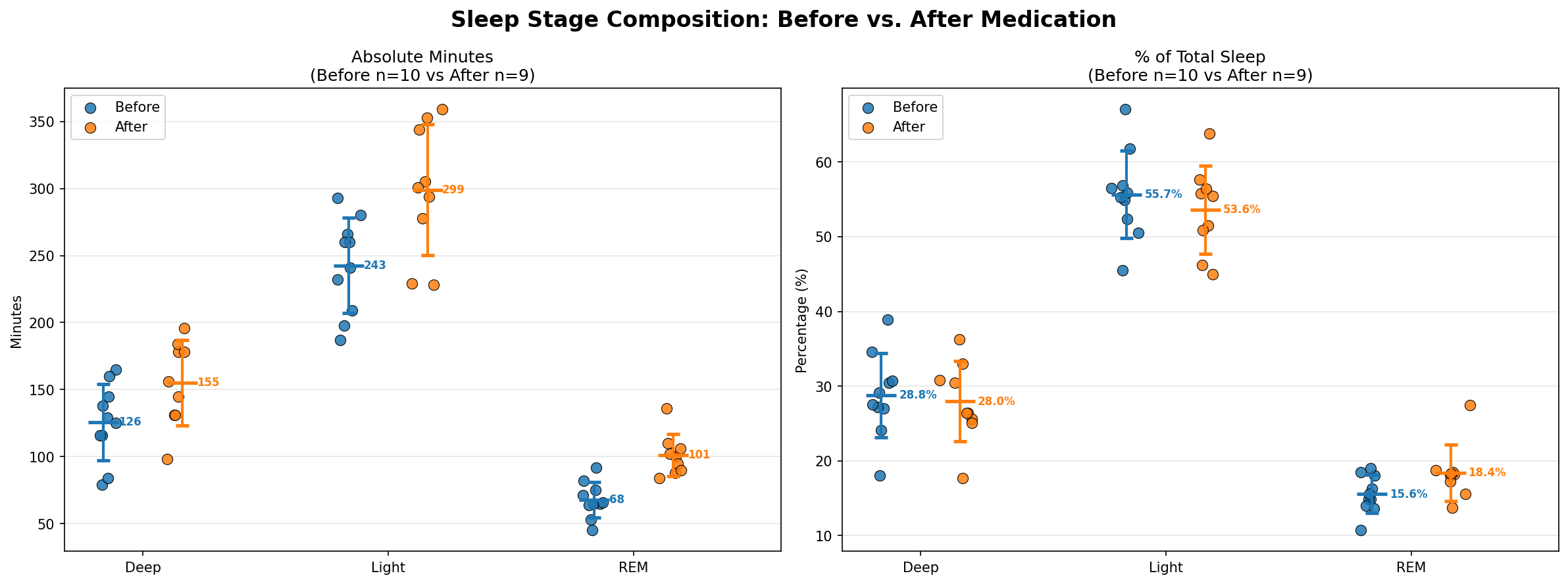
The data shows a shift in REM sleep. Before, REM made up about 15.6% of my total sleep. After, it went up to about 18.4%, with one night hitting 27.4%. The absolute minutes went up too, but that is expected since I slept longer. The percentage increase is a fairer comparison. Deep sleep stayed relatively consistent in both periods.
Adequate and quality REM sleep is critical for optimizing cognitive function, emotional regulation, and memory consolidation [3]. I am still figuring out why my REM sleep increased. It could be because I sleep longer overall, so I naturally spend more time in REM. Or it could be a direct effect of the medicine. But I cannot say for sure if this is the medicine or just natural variation.
Consistency vs. Timing
Before the medicine, my bed time was reliably around 1-2 AM. That kind of consistency was not a good thing. After the medicine, my bed time shifted to between 9 PM and midnight. That is a much healthier range.
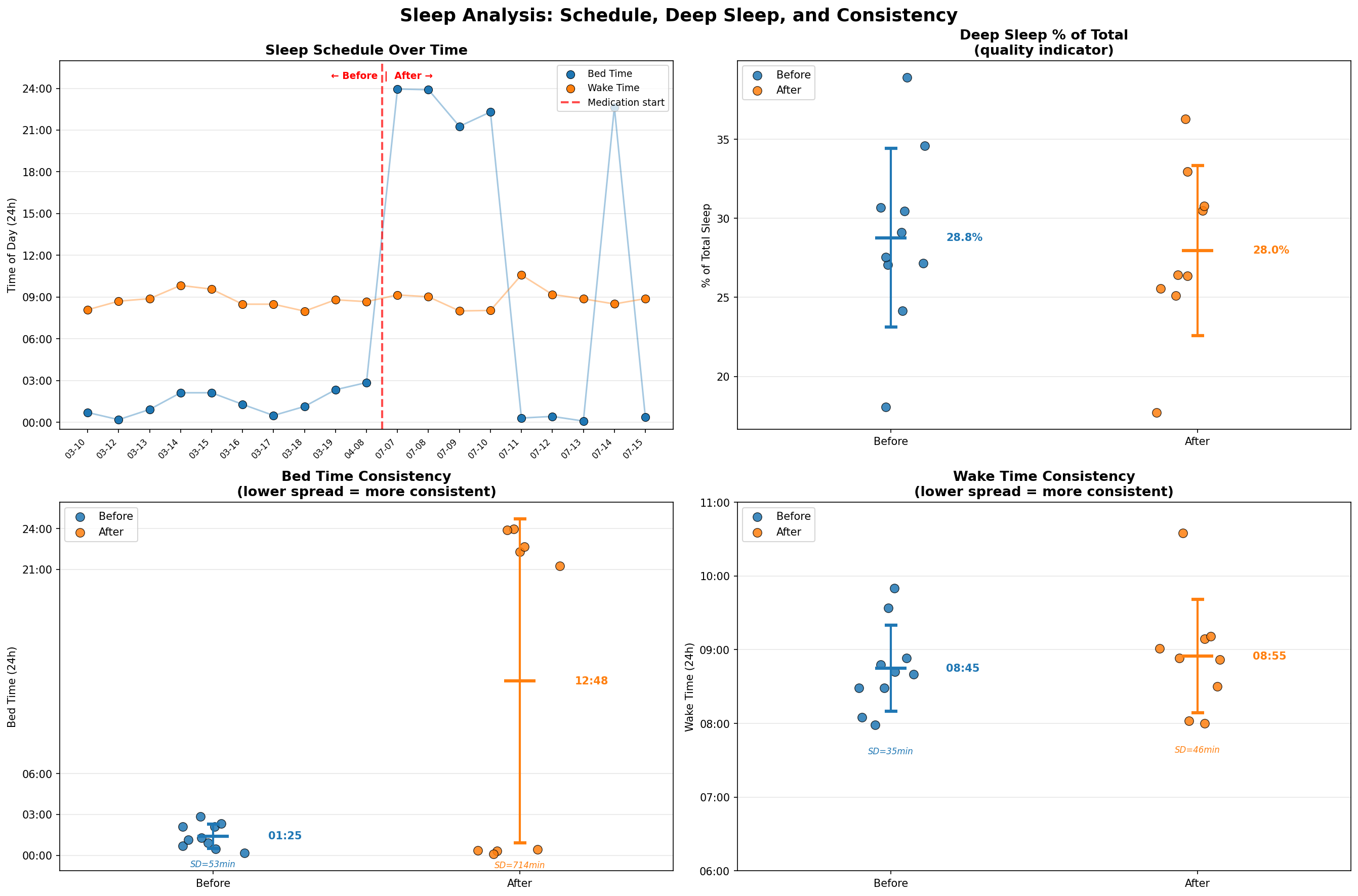
Before the medicine, my bed time varied by about 50 minutes. After, it varied by about 65 minutes. Some nights I went to bed at 21:16. Other nights at 00:25. The same happened with wake time.
Part of that is because I work as a DevOps engineer. Some days I still have to work until midnight. So the late bed times are not the medicine failing. They are just work.
Also, I take the pill when I am ready to sleep. Not at a fixed time. So the bed time range after medicine is really just when I chose to go to bed. The medicine does not force sleep at a specific hour. It just makes it easier to fall asleep when I decide to.
To be fair, the before data was already inconsistent. I was not tracking every night. So the before baseline is not a perfect measure of consistency either.
It might be because I was more relaxed about my schedule after the medicine. I was not stressed about falling asleep anymore, so I let myself drift.
What I Learned
The medicine changed my sleep. That is clear from the data. I sleep longer, I fall asleep earlier, and my sleep stage composition shifted.
But the data also shows things I did not expect. My sleep score went down. My bed time became more varied, but within a much healthier range. I still take time to fall asleep, just less than before.
If I only looked at the first few nights, I would have said this was a miracle. Looking at all the data together, the picture is more mixed.
This is not a recommendation. I am not saying anyone should take this medicine for sleep. I am just sharing what I observed in my own data. Your mileage will vary. Probably a lot.
References
[1] "HUAWEI TruSleep," Huawei Community. https://consumer.huawei.com/en/community/details/topicId-114588/ (accessed Jul. 15, 2026).
[2] "Introduction to sleep monitoring principles of HUAWEI smart wearables," Huawei Support. https://consumer.huawei.com/en/support/content/en-us15963854/ (accessed Jul. 15, 2026).
[3] P. Vorng, "The Role of Sleep in Cognitive Function and Memory," SSRN Journal, 2024, doi: 10.2139/ssrn.4993119.
[4] Y. Abdullah, "Deep Sleep Therapy: A Comprehensive Guide to Restorative Sleep Solutions," Journal of Sleep Disorders & Therapy, 2024, doi: 10.35248/2167-0277.24.13.564.